Why Does Media Selection Become Complicated in a Multi-Printer Workshop?
Investing in different printing technologies gives a production business more flexibility. Jobs can be assigned according to turnaround time, available capacity, print requirements and equipment capability. But that flexibility can become expensive when every machine requires a separate set of consumables. Blueback Poster Paper provides a useful example. From a customer’s perspective, the requirement may be straightforward: a printed outdoor advertising poster with sufficient opacity to cover previous graphics and suitable strength for its intended installation method. Inside the print shop, however, producing that poster involves several additional decisions. Which printer is available? Which paper grade has been approved for its ink system? Is the correct media preset installed? Does the required roll width match the machine? Is there enough material in stock to complete the job without changing batches halfway through?
These questions are connected. A purchasing decision affects production scheduling, and a production decision affects inventory. That is why media standardization deserves attention. Its purpose is not to eliminate every specialist product from the warehouse. It is to determine whether routine jobs can share an approved material specification, leaving dedicated grades for applications that genuinely require them. Before looking at the potential savings, however, it helps to understand why different printing systems may respond differently to the same paper.
Different Printers, Different Ink Requirements
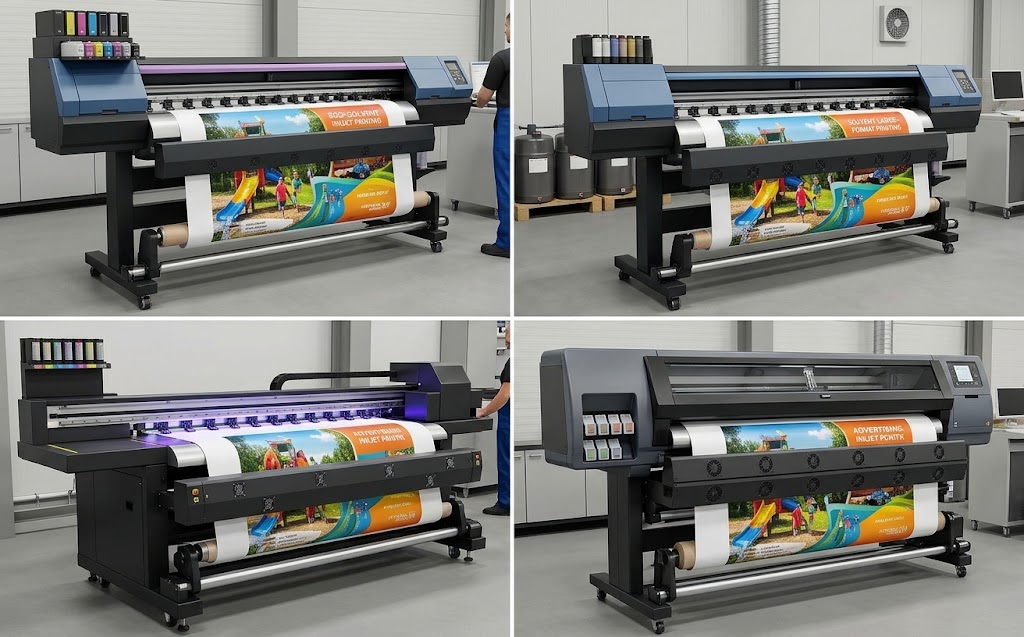
Eco-solvent, Solvent, UV and Latex printing systems can all produce high-quality advertising graphics. Their ink formulations and image-forming processes, however, place different demands on the printing media.
With solvent-family printing, interaction between the ink, liquid carrier and coated surface affects image formation, drying and final appearance. A coating needs to work with the intended ink formulation so that the print develops without unwanted spreading, poor definition or other surface problems. UV printing introduces a different consideration. UV-curable ink is deposited onto the material and subsequently cured through exposure to the appropriate ultraviolet light. Latex printing brings its own operating requirements. Depending on the printer generation and ink technology, media must perform under specified heating, drying or curing conditions. A material that looks acceptable at one setting may behave differently when the temperature or ink coverage changes. This is why a broad compatibility claim should always be read in context. Nor does compatibility with one model automatically establish compatibility with every printer using the same general ink technology. A practical way to evaluate multi-compatible paper is to separate three questions:
- Can the machine feed and process the material reliably?
- Can its ink system produce an acceptable, properly dried or cured image?
- Does the finished print retain the properties required by the advertising application?
The Hidden Cost of Stocking Multiple Poster Paper Grades
Not every combination will be consumed at the same rate. One printer may handle most of the outdoor poster orders during a busy month, leaving material reserved for the other machines untouched. Another machine may suddenly receive an urgent job, but the appropriate paper is available only in a width that creates unnecessary trimming waste. The cost is not limited to storage space. Every additional SKU requires purchasing attention, stock monitoring and replenishment decisions. Opened rolls need appropriate storage and protection. Depending on packaging and environmental conditions, poorly stored paper may also be exposed to moisture or physical damage. Production planning becomes more restrictive when jobs cannot easily be moved between machines because their approved papers are different.
However, this does not mean that switching between paper grades always creates significant downtime. The actual changeover cost depends on the equipment, existing presets and how the shop organizes production. A better assessment uses the business’s own records. Review the previous three to six months of Blueback consumption. Identify the grades and widths that move quickly, the materials that regularly remain partially used, and the jobs that have been delayed by unavailable stock. Then estimate the combined cost of purchasing, handling, storage, unusable remnants and material-related production interruptions.
What Makes Blueback Paper Compatible with Different Ink Systems?
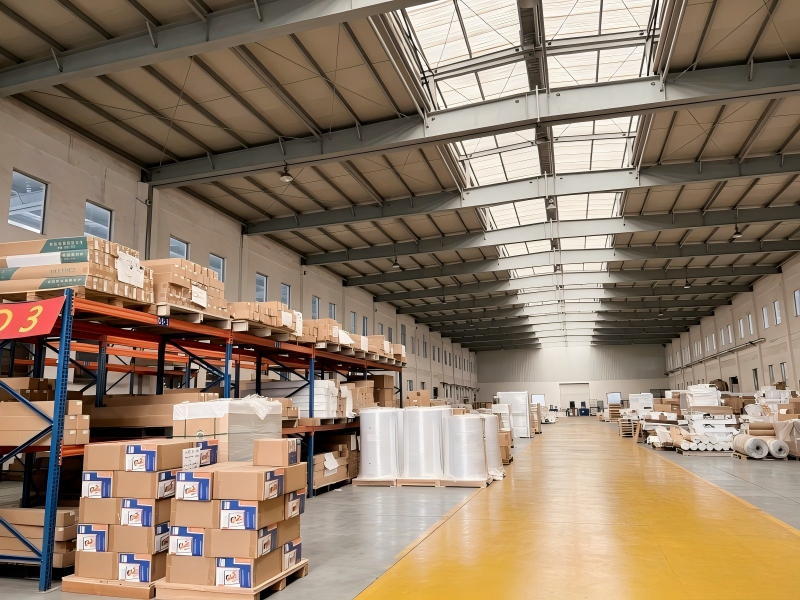
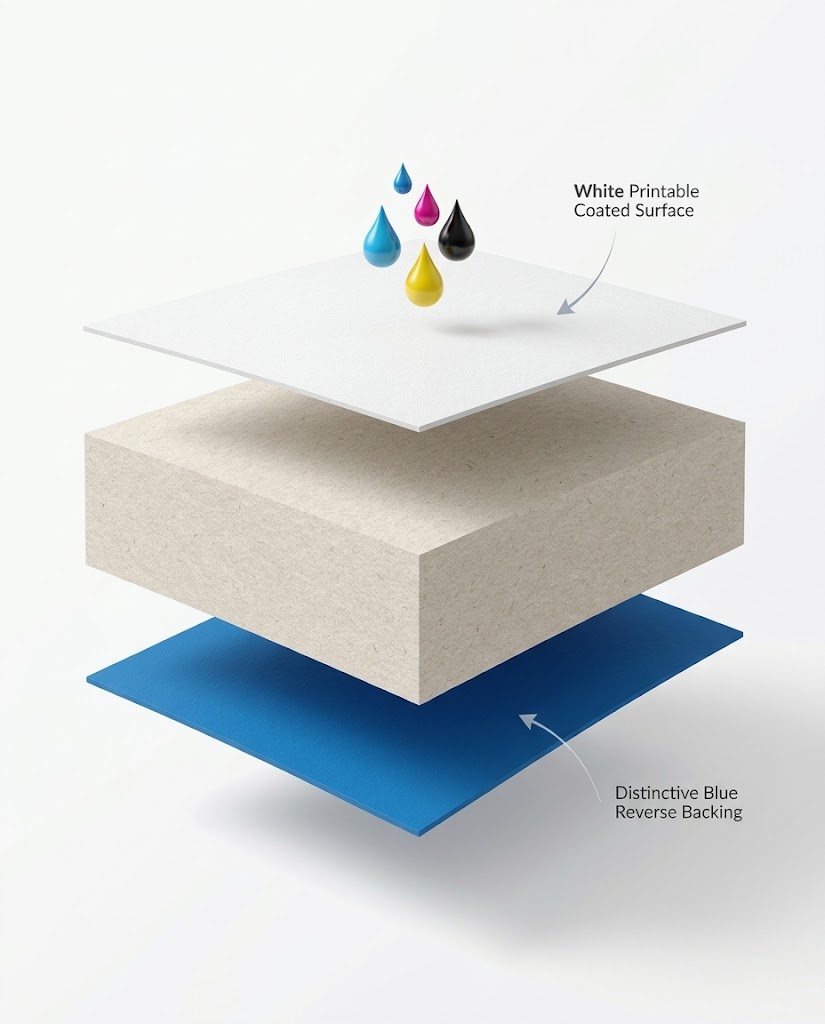
Blueback Paper is often identified by its distinctive reverse side, designed to reduce show-through from the surface underneath the new advertising graphic. That backing addresses an important application requirement, but it tells us relatively little about compatibility with different digital printing systems. For a print shop evaluating All-in-One media, the printable face deserves closer attention. Its coating must support the intended printing processes while working with the underlying paper structure. Consistency across the material is important as well: a coating that performs well in one small area but varies across the roll can cause difficulties during production. The challenge is therefore not simply to make ink stick to paper. Different inks have different requirements, and those requirements must be balanced without sacrificing the paper’s intended use as an advertising medium.
This is also why product-specific information matters more than broad marketing language. Two Blueback products may have the same nominal GSM and a similar appearance but differ in their surface treatment, coating formulation, printing compatibility or intended applications. A manufacturer offering a multi-compatible grade should be able to identify the actual product model and describe its supported printing systems. The next question belongs to the print shop: how does that product behave on the equipment already installed in the workshop?
How Coating Design Supports Different Printing Technologies
For UV-curable printing, wetting and adhesion are particularly important. The ink must form a satisfactory printed layer and cure adequately on the coated surface. Surface chemistry matters, but it should not be considered independently from the ink formulation and the machine’s curing conditions. Latex printing requires the material to remain compatible with the relevant ink and thermal processing conditions. The coating and paper construction must work together under the settings recommended for the particular printer and media combination. These are different requirements, but they are not necessarily mutually exclusive. Coating formulations can be developed to support multiple printing technologies. The commercial availability of multi-compatible poster papers demonstrates that printers do not always need a completely different substrate for each ink family.
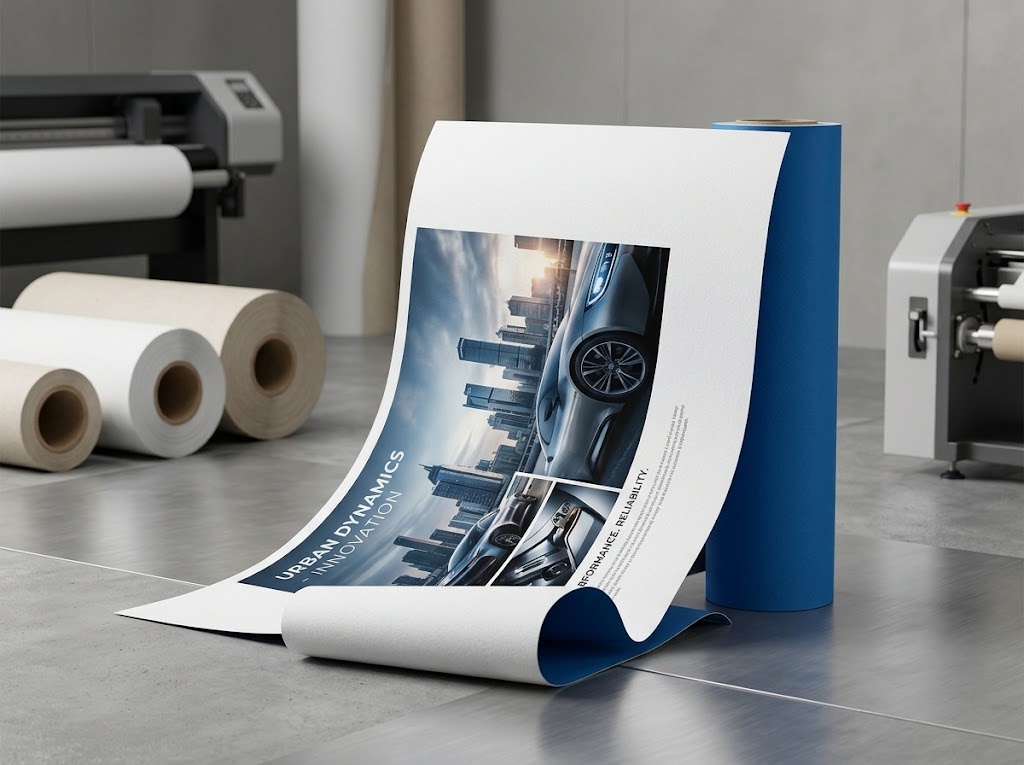
At NAISI, our Blueback range includes grades developed for different printing requirements. The FPH-125VMB 125gsm Blueback Poster Paper is an All-in-One option supporting Eco-solvent, Solvent, UV and Latex printing applications. Its wet-strength base paper, blue backing and water-resistant surface treatment address application needs beyond image reproduction. The exact suitability for a particular printer and workflow should still be confirmed through product information and testing. That is the difference between engineering a material for broad compatibility and claiming that one roll can solve every printing problem.
Why Compatibility on a Data Sheet Still Needs Real Print Testing
A technical data sheet is an essential starting point, but it cannot reproduce every condition inside a customer’s production facility. Two print shops may use the same Blueback grade and achieve different results because their equipment, inks, media presets and operating environments differ. Even within one business, an Eco-solvent printer and a Latex printer may need different settings to produce comparable artwork. Before standardizing a multi-compatible Blueback, conduct a structured trial on every machine intended to use it.
First, establish a common test file. Include solid color blocks, fine text, detailed photography, neutral greys and smooth gradients. These elements make it easier to identify differences in density, edge definition and color reproduction.
Second, assess drying, curing and ink adhesion. For solvent-family output, observe whether the print reaches an appropriate handling condition within the expected production workflow. For UV printing, assess curing and adhesion using an appropriate procedure agreed with the ink or equipment supplier. Adhesion tests should be performed consistently. A random tape test without an agreed method, conditioning time or acceptance criteria can produce misleading comparisons.
Third, test how the printed material behaves after production. Allow for the required drying or curing conditions, then handle, fold or process representative samples according to the intended application. If the paper will be wet-pasted onto walls or existing posters, include an installation trial. Examine the printed surface as well as the physical condition of the paper.
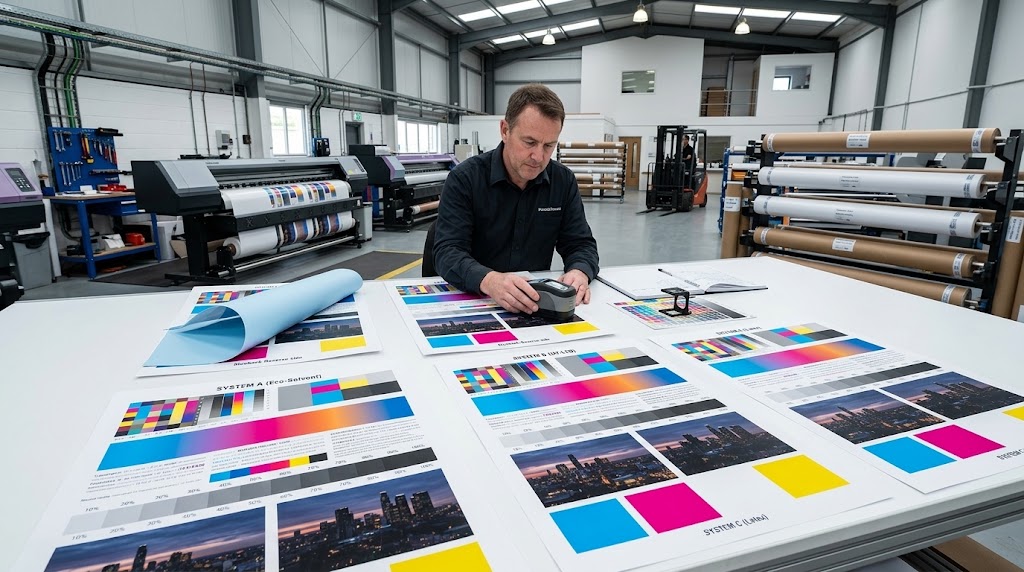
Fourth, verify production feeding. A successful small print does not necessarily reveal problems that may occur during longer runs. Evaluate feeding, tracking, winding and any equipment-specific handling requirements using a representative production length. Finally, document the findings rather than relying on an operator’s general impression. A simple pass/fail record for each machine, supported by retained samples, provides the basis for an internal approved-media list.
How Can Print Shops Simplify Blueback Paper Purchasing Without Compromising Quality?
Once cross-platform performance has been established, the discussion can move from printing technology to purchasing strategy. This is where an All-in-One Blueback can offer practical value. The opportunity lies in reducing unnecessary material variations while preserving the ability to select dedicated media when the job requires something different. But standardization is not automatically an improvement.
If a shared grade is significantly more expensive, unsuitable for a commonly used machine or available only in inconvenient roll dimensions, simplifying the inventory list may do little to improve profitability. The comparison needs to include the full production workflow. A print shop should also distinguish between standard production and exceptional projects. The majority of recurring outdoor poster orders may share similar requirements, while a smaller number involve different ink systems, unusual dimensions, special finishes or longer-term applications.
When Does an All-in-One Blueback Paper Make Sense?
An All-in-One Blueback makes the strongest commercial case when several printers handle similar types of poster work and the shop would benefit from sharing part of its media inventory. Imagine that a business regularly produces short-term outdoor advertising on Eco-solvent, UV and Latex equipment. Rather than holding a dedicated paper for each machine, it may be able to approve one multi-compatible grade for routine jobs, allowing production planners more freedom to allocate orders according to machine availability. A useful comparison should account for the purchase price, roll yield, trimming waste, test prints, unusable remnants, inventory requirements and material-related production losses. For example, a less expensive paper may still be the poorer commercial choice if its available roll widths result in substantial waste for the sizes most frequently printed.
NAISI’s FPH-125VMB 125gsm Blueback Poster Paper can be considered for businesses looking to consolidate routine production across Eco-solvent, Solvent, UV and Latex systems. Its multi-system positioning provides a starting point for standardization, not a guarantee that every machine will operate without adjustment. It is equally important to recognize where an All-in-One product is not the appropriate answer.
What Should You Confirm Before Standardizing Your Poster Paper Supply?
Once a candidate Blueback grade has performed well during initial testing, there is still work to do before it becomes the standard material across a printing business. Start by confirming the exact product model. A generic description such as “125gsm Blueback Paper” is not sufficient for repeat purchasing. The supplier should identify the grade clearly, including its intended printing compatibility, product specifications and available roll dimensions.
Next, check whether those dimensions fit the existing equipment. Roll width and length affect production planning, while core size and other physical requirements need to match the printer’s media-handling system. These details may seem less interesting than coating technology, but an incompatible roll specification can prevent an otherwise suitable paper from being used efficiently. Repeat advertising campaigns often require comparable image appearance between orders. The print shop should discuss how the manufacturer manages relevant product characteristics and what procedure is available if a new delivery behaves differently from a previously approved batch.
Do not assume that color consistency is solely a paper issue, however. Printer condition, ink, profiles and operating settings must also be controlled. Before changing the purchasing policy, record which printer models have successfully passed the qualification process and retain the approved settings. If the business introduces a new printer or changes its ink system, review compatibility rather than automatically extending the original approval. Finally, discuss technical support and sampling arrangements with the manufacturer. A useful supplier relationship should make it easier to evaluate materials, identify the appropriate product grade and communicate technical concerns when they occur.
NAISI manufactures Blueback Poster Paper for different digital printing requirements, supported by more than 20 years of coating technology experience. If your print shop is considering consolidating its Blueback inventory, share your printer models, ink systems, required roll dimensions and typical applications with our team. We can help identify a suitable product grade and discuss samples for testing on your own equipment.