Shifting Priorities from Short-Run Flexibility to Volume Consistency
The biggest change in high-volume printing is the shift from individual job performance to repeatable production performance. In a short run, an operator can make several small adjustments without significantly affecting the overall schedule. A colour correction, a slower print pass or a replacement sheet may be manageable. When the same job runs continuously across multiple rolls, those adjustments become potential sources of variation. For a large-format printing business, the question is no longer simply whether a material can produce an attractive poster. It is whether the same material can maintain predictable behaviour throughout the planned production run. This includes consistent colour appearance, surface quality, dimensional stability, ink acceptance and handling performance.
The cost of inconsistency also becomes easier to underestimate. A single defective poster may have little financial impact. A recurring defect affecting 3% of a 5,000-unit order means 150 pieces may need inspection, reprinting or replacement. The problem may also consume additional media, machine time, labour and packaging resources. This is why high-volume print production requires more preparation than simply increasing printer speed. The production team needs agreed specifications, stable operating parameters, a material supply plan and a clear method for identifying deviations. The following two factors are particularly important: maintaining batch consistency across multiple rolls and ensuring that printing speed does not exceed the practical drying capacity of the complete system.
Why Batch Consistency Becomes Critical Across Multi-Roll Production
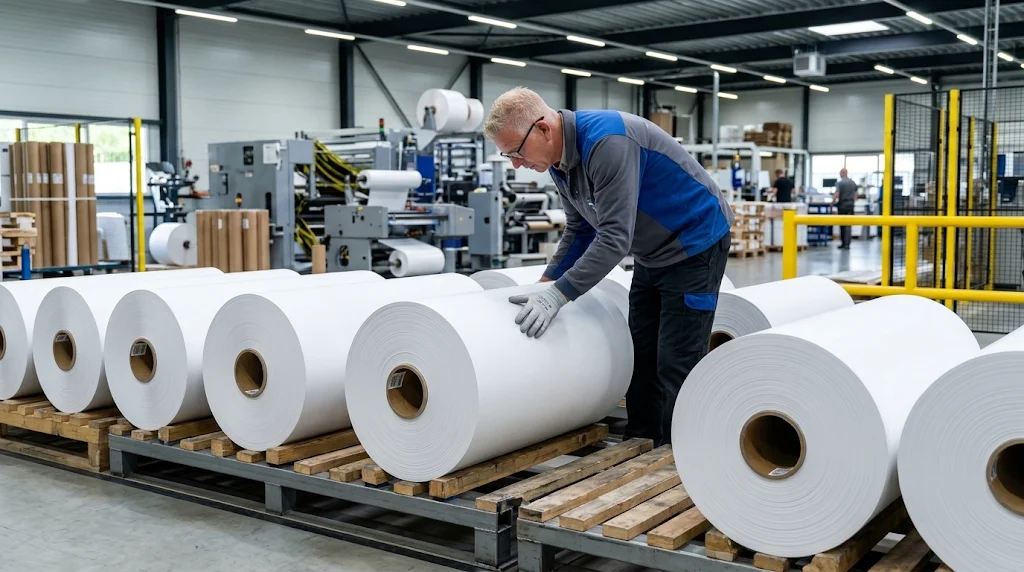
One of the first challenges in a large print order is keeping the output consistent when production moves from one roll to another. A 5,000-poster campaign may require several rolls of media, and those rolls may not always come from the same manufacturing batch. Even when the product name, nominal weight and dimensions are identical, differences in surface properties can affect the final result. For example, variations in paper whiteness, coating uniformity, gloss, thickness or moisture content may influence how a printed image looks and how the media behaves during processing. These differences are not necessarily obvious when rolls are inspected individually. They become much easier to notice when posters from different production stages are placed side by side, particularly in retail displays, outdoor advertising campaigns and coordinated promotional installations.
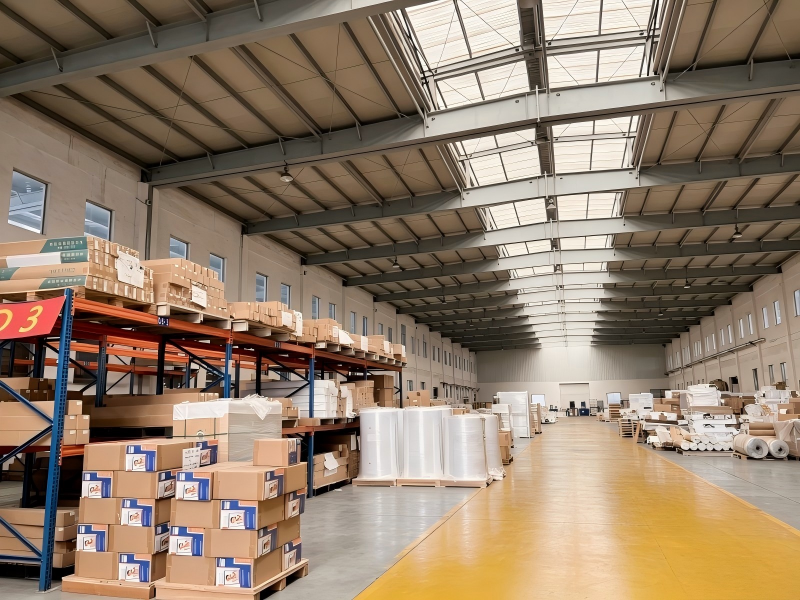
Batch control should therefore begin before printing. Where possible, buyers should request rolls from the same production batch and confirm whether the supplier can reserve sufficient stock for the entire order. If multiple batches must be used, the production team should record roll numbers, manufacturing information and the sequence in which each roll enters the printer. A small sample from each batch can also be checked before committing to the full run. However, batch matching alone does not guarantee identical results. Printer calibration, ink condition, colour profiles, temperature and humidity can also influence output. A stable workflow needs both consistent media and controlled printing conditions.
For buyers sourcing large-format printing media, this changes what a useful specification looks like. Instead of checking only product name, GSM and roll width, it is worth discussing batch availability, dimensional tolerances, surface consistency and traceability. The most suitable material for a large order is not necessarily the one with the highest specification. It is the one that can deliver dependable performance across the entire production quantity.
Managing Printer Speed and Drying Efficiency at High Volumes
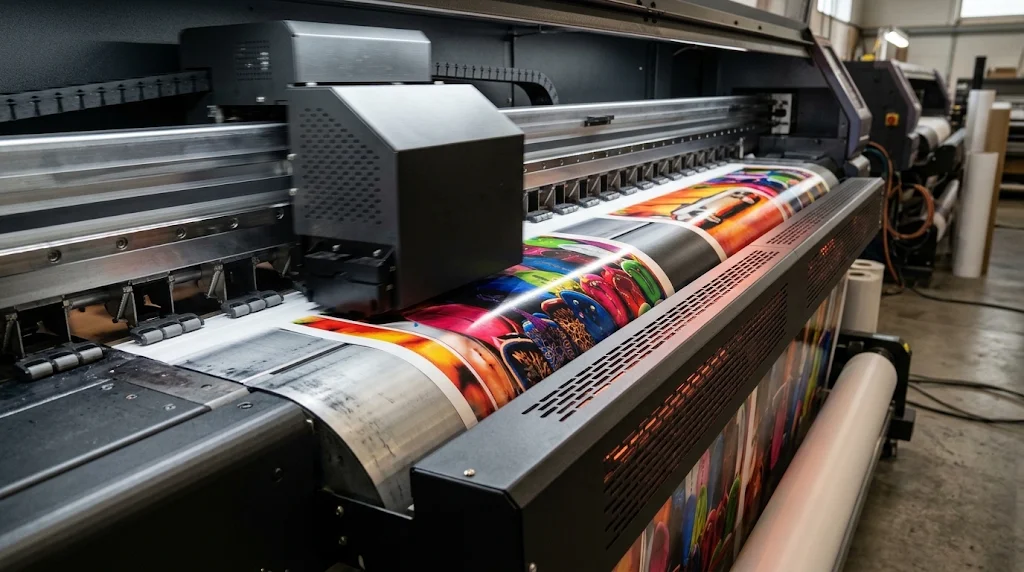
Increasing printer speed seems like the most direct way to shorten a large production schedule. In practice, speed is only useful when the rest of the printing process can keep up. If ink is deposited faster than the substrate can accept and dry it, higher output settings may lead to bleeding, mottling, uneven colour, surface transfer or other quality problems. The relationship between printer, ink and substrate becomes particularly important in high-volume printing. A coating that performs well at a moderate pass rate may respond differently when the machine runs continuously at a higher speed or uses a heavier ink load. Ink formulation, print mode, resolution, heater settings and environmental conditions all influence the result. There is no single speed setting that works equally well for every media and printer combination.
Drying capacity also affects what happens after printing. If the printed surface is not sufficiently dry before rewinding, stacking or cutting, ink may transfer to another surface or become damaged during handling. This can create a bottleneck even when the printer itself is producing material quickly. In other words, the fastest printing stage does not determine total production speed; the slowest reliable stage often sets the pace. Longer rolls can reduce the number of media changes and help improve print production efficiency. However, they also require suitable roll handling, stable winding tension and adequate storage conditions. A longer roll is beneficial only when the printer and finishing equipment can handle it consistently.
Before starting a full-volume order, conduct a production-speed test using the intended media, ink, print mode and drying settings. Check image quality immediately after printing and again after the media has been rewound or handled. This reveals problems that a short, slow sample test may miss. The objective is not to find the highest possible printer speed, but to identify the fastest operating condition that maintains acceptable quality throughout the run.
Logistics, Finishing, and Quality Control at Scale
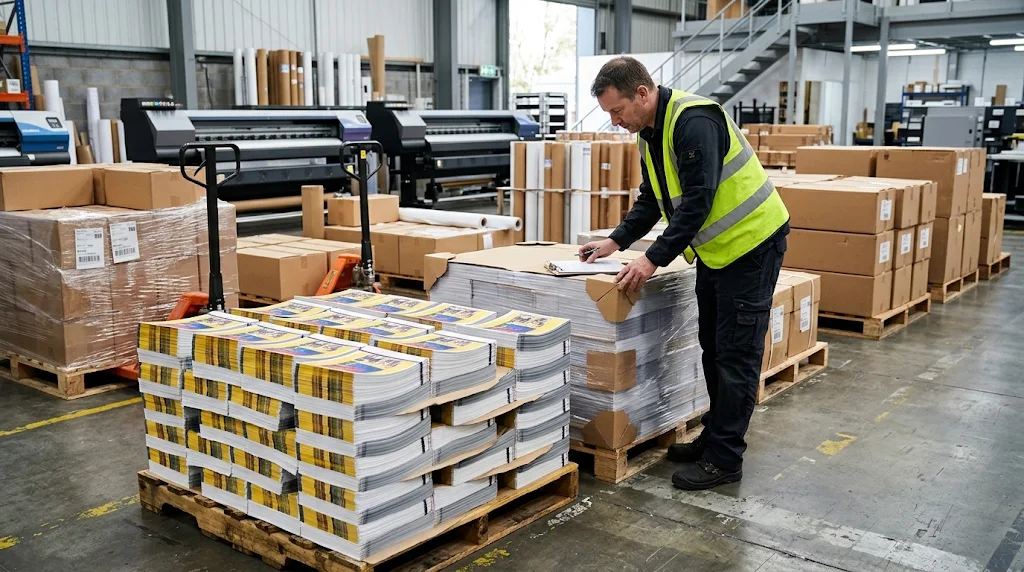
A large print job does not end when the last metre comes out of the printer. In many production environments, the most demanding work begins after printing: trimming, cutting, sorting, counting, bundling, packing and preparing orders for dispatch. These operations must be planned alongside the printing schedule, otherwise finished material can accumulate faster than the team can process it. This is one of the main differences between ordinary large-format printing and industrial print scaling. A small order can often be handled manually from beginning to end. A large order needs a coordinated production flow, with clear responsibilities and enough capacity at each stage. If printing produces 1,000 posters per hour but cutting can only process 500, the finishing department becomes the bottleneck. Increasing printer speed will not solve that problem.
Quality control also needs to move beyond checking a few finished pieces. At scale, inspection should take place at defined points throughout production. Teams may need to check the first output from each roll, monitor dimensions at regular intervals, inspect cutting accuracy and verify the quantity of each packed bundle. Defects should be recorded with the relevant roll or batch information so that problems can be traced rather than treated as isolated incidents. Packaging and delivery add another layer of complexity. A 5,000-piece campaign may involve multiple sizes, destinations or shipment dates. Without clear identification and sorting procedures, correctly printed posters can still be mixed, damaged or sent to the wrong destination. The practical lesson is that printing, finishing and logistics should be treated as one connected process. The following two areas help prevent a high-volume order from becoming a finishing or delivery problem.
Automating Post-Print Cutting and Packaging for Large Batches
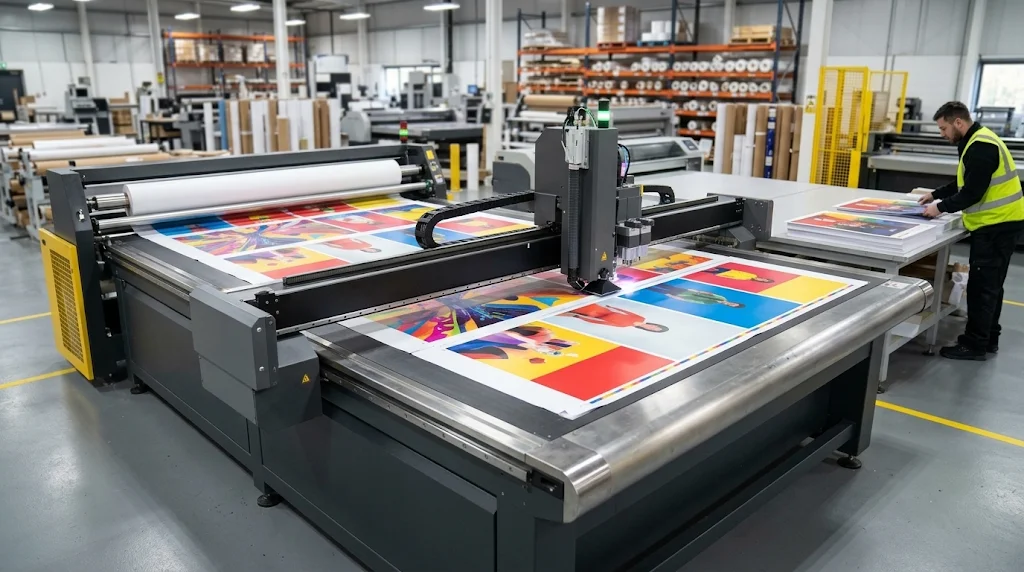
Manual cutting and packing are often perfectly adequate for short runs. They offer flexibility and require relatively little setup, especially when the order includes unusual sizes or frequent design changes. However, as quantities increase, manual handling takes more time and introduces more opportunities for inconsistent measurements, misplaced pieces and accidental damage. For large batches, automated or semi-automated cutting equipment can improve throughput and repeatability. Guillotine cutters, roll-fed cutters and other finishing systems can process repeated dimensions more consistently than manual methods, provided the material and equipment are properly matched. The correct solution depends on the poster format, media construction, production volume and required cutting tolerance.
Substrate behaviour matters here. Media stiffness, thickness, curl, surface friction and roll condition can all affect feeding and cutting accuracy. If the material shifts during processing, even a well-configured cutting machine may produce uneven edges or incorrect dimensions. This is why finishing compatibility should be considered when selecting media, rather than evaluated only after printing has finished. Packaging requires the same level of planning. For a 5,000-poster order, the team should decide in advance how many pieces belong in each bundle, how different sizes will be separated and what protection is needed during storage and transport. If the customer requires staged deliveries, bundles should be identified by shipment date, destination or order reference. This makes it easier to verify quantities and reduces the risk of mixing different parts of a campaign.
Automation does not automatically eliminate errors. Equipment still needs calibration, operators need clear procedures and finished products need regular inspection. Its real value is reducing unnecessary handling and making repetitive tasks more predictable. When cutting, sorting and packaging are designed around the expected production volume, the finishing line can support the printer instead of slowing it down.
Ensuring Stable Supply and Predictable Delivery Schedules
A production schedule is only as reliable as the material supply behind it. For a short print job, a missing roll may be inconvenient but relatively easy to replace. For a large-volume order, a shortage during production can interrupt the entire workflow, leaving machines idle and putting delivery commitments at risk. Before accepting a high-volume order, the print provider should confirm more than the supplier’s usual stock availability. It is important to establish whether the required quantity can be supplied within the agreed period, whether sufficient rolls can be reserved and whether additional material will be available if testing or reprinting becomes necessary. Lead times should also account for converting, slitting, inspection and transportation, not just the time needed to manufacture the base material.
Roll specifications need to be checked against actual production requirements. Width, length, core diameter, roll weight and winding condition can influence whether the material is compatible with the printer and handling equipment. A supplier may offer a product in the correct nominal width but still need to confirm the available roll configuration for a particular production line. Traceability is equally important. Recording roll identification, batch information, production dates and usage sequence helps the team investigate defects and isolate affected output. If a problem appears halfway through the order, these records can help determine whether it is related to one roll, a particular batch or a change in printer conditions.
Delivery planning should be agreed at the same time. Some customers need the full quantity delivered together, while others require phased shipments for different locations or campaign dates. Those requirements affect how finished posters are sorted, packed, stored and released. Reliable supply is therefore part of high-volume print quality. A media product that performs well but cannot be supplied in sufficient quantity is not a dependable choice for a large campaign. The best production plan connects material availability, batch control, finishing capacity and delivery dates before the order enters full production.
Planning for Scale, Not Just for Speed
The difference between 50 posters and 5,000 is ultimately a difference in how the entire job is managed. A small order can often rely on operator experience and quick decisions. A large order needs a process that can repeat the approved result without depending on constant intervention. That means material selection, printer settings, drying capacity, finishing equipment, quality checks and delivery arrangements must be considered together. For print service providers, the most useful preparation starts before production. Confirm the media specification and batch availability, test the intended printer and ink combination at realistic operating conditions, and check that cutting and packaging can handle the expected output. Establishing inspection points and recording roll information also makes it easier to identify problems early, before they affect a significant part of the order.
For buyers, the conversation with a media supplier should go beyond price per square metre. Ask whether the required quantity can be supplied consistently, what roll configurations are available and how batch information can be traced. These details may have little impact on a small sample order, but they can make a substantial difference when production runs across multiple rolls and several working shifts. At NAISI, we understand that printing media needs to do more than deliver a good-looking first print. For large-format applications, stable coating performance, consistent roll quality and dependable supply all contribute to a smoother production process. Choosing media with the actual production conditions in mind helps print providers reduce avoidable interruptions and maintain a more consistent result. A 50-poster job tests whether a print can be produced well. A 5,000-poster job tests whether the whole production system can keep producing it well. That is what changes when a print job scales up.