How Your Display Environment Determines Paper Choice
Before comparing paper grades, look at the job itself. Where will the poster be installed? How long will it stay there? What printer and ink will be used? Will it be pasted over an existing graphic? Will people view it from a few metres away, or will they stand close enough to notice fine image detail? These questions usually tell you more than a product catalogue does.
Outdoor Billboards and Short-Term Outdoor Campaigns: Why Blueback Still Rules
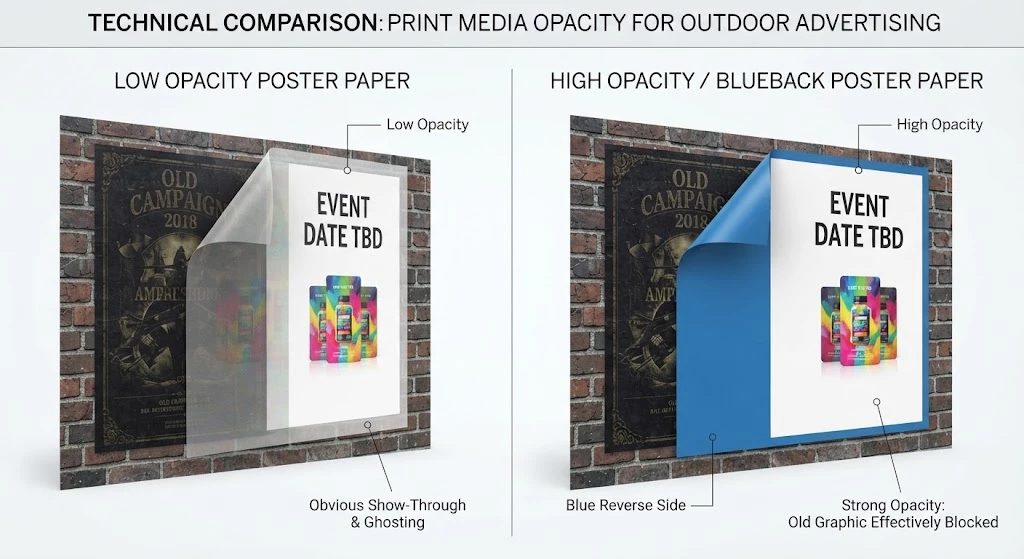
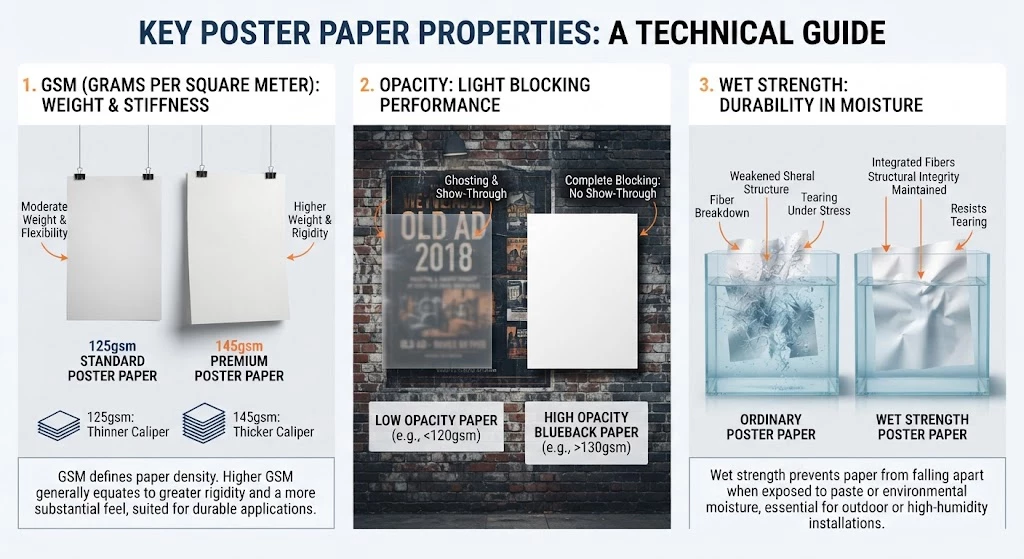
Outdoor paste-up has one problem that indoor printing usually doesn’t: You cannot control what is behind the poster. The surface may be a dark wall, an old advertisement, painted concrete or another graphic. If the new paper allows too much light through, the background starts competing with the new image. That is why Blueback Poster Paper remains widely used for billboards, wall posters and other short-term outdoor advertising. The blue reverse side is functional. Its main job is to reduce show-through and help the new graphic remain visually independent from the surface underneath.
But opacity is only part of the story. Installation is another major consideration. A poster may be soaked with paste before it reaches the wall. It can be pulled, repositioned and smoothed during installation. Outdoor humidity or light rain can make the situation even harder. This is where wet strength becomes important. A paper that loses too much strength when wet can stretch, tear at the edges or become difficult to handle. A paper that looks perfectly acceptable when dry may behave very differently during installation. When comparing Blueback papers, I would pay particular attention to four things:
- Opacity / backness: especially important when printing over dark or existing graphics.
- Wet strength: determines how well the sheet holds together during wet installation.
- Surface water resistance: useful when the poster may encounter light moisture during installation or short-term outdoor use.
- Tear resistance: important when handling large-format sheets on site.
For example, NAISI offers 125gsm and 145gsm Blueback Poster Paper for different printing and application requirements. The 125gsm grade is a practical option when you want a lighter, easier-to-handle material for general advertising work. The 145gsm grade provides more body and stiffness, which can be useful for larger-format posters and more demanding installation conditions. The important point is that 145gsm is not automatically “better” than 125gsm. The better choice depends on the printer, poster size, installation method and required handling strength.
And one more point is worth making: Blueback is generally intended for short- to medium-term advertising applications. If a campaign has to survive for months in severe outdoor conditions, it is worth discussing synthetic media, lamination or another more durable construction with your supplier.
Indoor Retail and Promotional Displays: Whiteback vs. Photo Paper
Move the same poster indoors and the priorities change. You no longer need to design around rain or wet paste-up. Instead, the focus usually shifts to print appearance, colour reproduction, surface finish and cost per square metre.
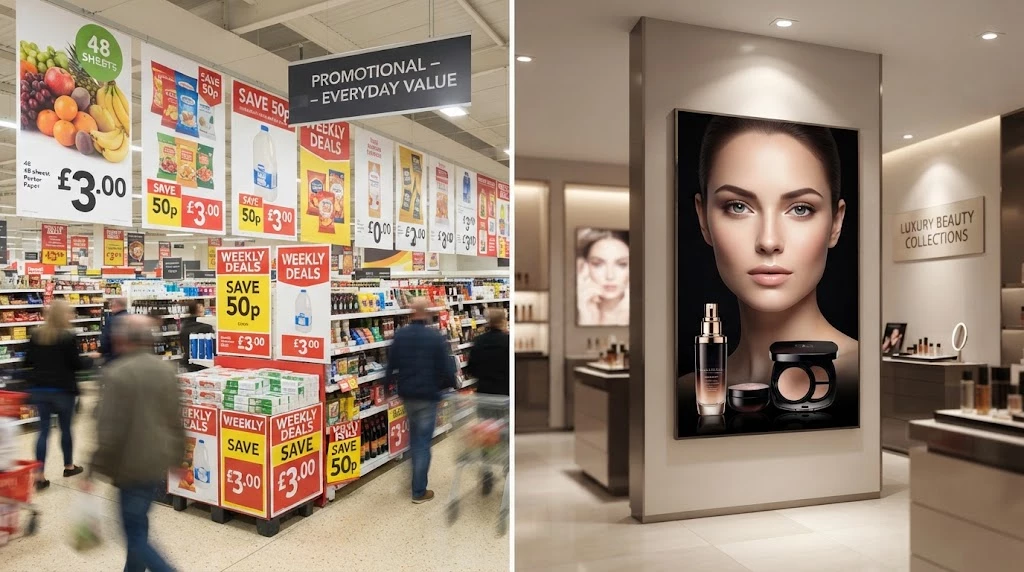
Consider two very different jobs. A supermarket may need several thousand posters for a three-day promotion. The artwork contains product images, large prices and bold promotional text. The posters need to look clean, but the economics of the entire campaign matter.
A cosmetics brand may need one large image for a flagship store. The artwork contains skin tones, subtle gradients, product highlights and fine details. Here, the print itself is part of the brand experience. Both are poster jobs. They shouldn’t necessarily use the same paper. Whiteback Poster Paper is often the sensible choice for volume retail work. It provides a bright printable surface and a practical balance between print quality and cost. It works well for promotional posters, seasonal retail graphics and other applications where thousands of square metres may be involved.
Poster Photo Paper is better suited to image-driven work where surface appearance and fine detail matter more. Its smoother coated surface can produce higher image definition, stronger colour density and cleaner reproduction of photographs, gradients and small details. A simple way to look at the difference:
Whiteback: efficient production for high-volume advertising. Photo Paper: when the printed image itself needs to look premium. Using Photo Paper for every retail promotion can simply add unnecessary cost. Using an economical Whiteback for a high-end beauty campaign can save money in the wrong place.
What Happens Between the Printhead and the Finished Image?
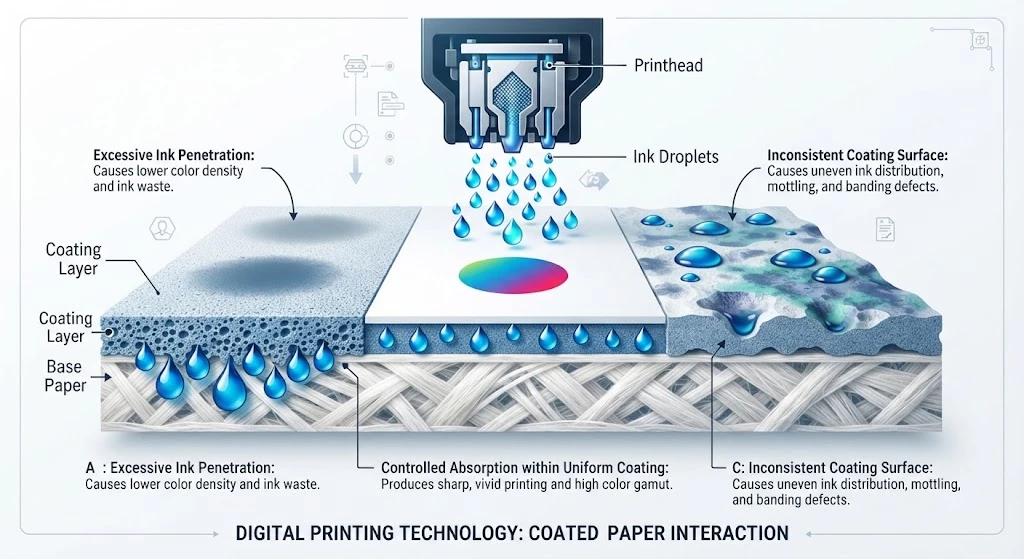
Once you know where the poster will be used, the next question is more technical: What happens when the ink actually lands on the paper? The printer controls the position of the ink droplets. The coating largely determines what happens next.
Coating Chemistry and Its Impact on Print Quality
When an ink droplet reaches a coated paper surface, it needs to behave in a controlled way. If the ink penetrates too quickly, colour density can suffer. If it remains too much on the surface, drying and handling can become problems. If the coating is inconsistent across the roll, the same artwork can look different from one area to another. This is why two papers with exactly the same GSM can behave very differently on the same printer. For poster printing, three coating-related properties deserve particular attention.
Whiteness and brightness. The base paper provides the starting point for the printed image. A clean, bright white surface can help colours appear more vivid and maintain good contrast. However, a single whiteness number does not tell the whole story. When comparing suppliers, it is better to look at the complete technical data rather than choosing a paper simply because one specification appears higher.
Surface smoothness. A smoother printing surface can help reproduce small text, fine lines and photographic detail more cleanly. This becomes especially noticeable in close-view applications such as retail graphics, product photography and premium promotional displays.
Coating uniformity. This is easy to overlook. A paper can have an attractive specification sheet and still cause problems if the coating is not consistent across the roll. Variation can show up as differences in colour density, ink absorption or print appearance. For production printers, consistency is often more valuable than one impressive number on a TDS.
GSM, Opacity and Wet Strength: What the Numbers Actually Tell You
GSM is useful. But GSM alone does not tell you whether a poster paper is good. A 145gsm paper is heavier than a 125gsm paper. That tells you something about handling and stiffness. It does not tell you which one will produce better colour, better ink absorption or better outdoor performance. For example:
- 125gsm Blueback: lighter and easier to handle, suitable for many standard poster and short-term advertising applications.
- 145gsm Blueback: more body and stiffness, useful for larger formats or situations where handling strength matters more.
But the choice should not stop at weight. For outdoor paste-up work, opacity and wet strength can matter more than a 20gsm difference. Opacity determines how effectively the new poster hides the surface underneath. This is particularly important when replacing old campaigns or covering dark backgrounds. Wet strength determines how well the paper retains its physical integrity after becoming wet during installation. So if someone asks: “Should I choose 125gsm or 145gsm?” The useful answer is not simply ‘145gsm is better.’ The better question is: What printer are you using, how large is the poster, how will it be installed, and what is behind it? That is the information a good paper supplier should ask for before recommending a grade.
Which Poster Paper Fits Your Advertising Application?
There is no single poster paper that works best for every advertising job. The easiest way to narrow the choice is to start with the environment and work backwards.
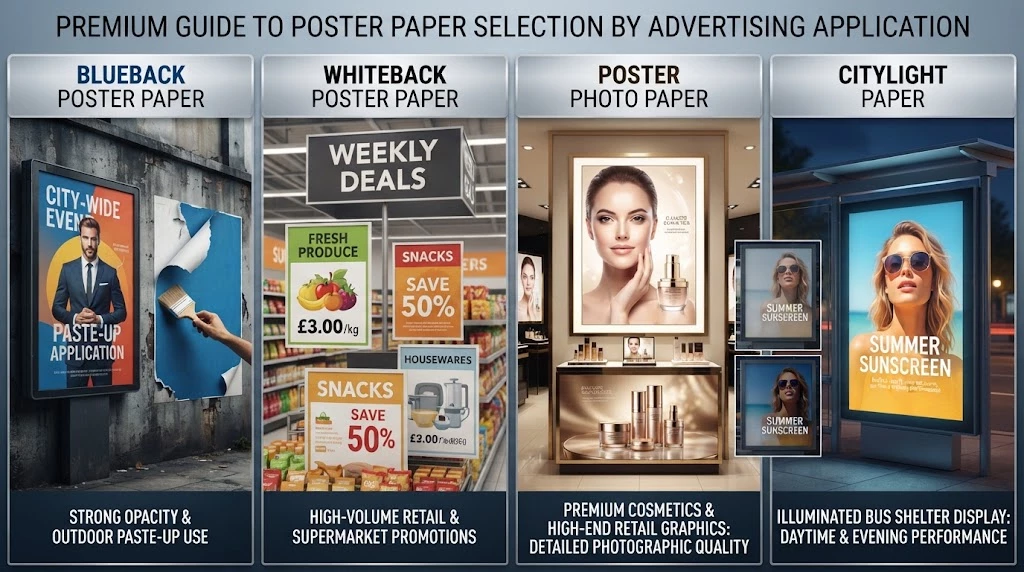
| Application | Recommended Paper | What to Check |
| Outdoor billboard / wall poster | Blueback Poster Paper | Opacity, wet strength, water resistance, tear resistance |
| Indoor retail / supermarket promotion | Whiteback Poster Paper | Print consistency, ink compatibility, cost per sqm |
| Photo-heavy / premium retail graphics | Poster Photo Paper | Smoothness, colour density, coating uniformity |
| Bus shelter / Citylight / illuminated display | Citylight Paper | Wet strength, backlit appearance, colour consistency |
Blueback, Whiteback, Photo or Citylight?
Outdoor billboard or wall poster? Start with Blueback. If the poster is going over an existing graphic, check opacity first. If it will be wet-mounted, ask about wet strength.
Large-volume retail promotion? Whiteback is usually the more economical choice. For thousands of posters, a small difference in material cost per square metre can become a significant difference in the final project cost.
Bus shelters and illuminated displays? This is where Citylight Paper deserves separate consideration. A Citylight poster does not live under one fixed lighting condition. It may be viewed in daylight, under artificial lighting and again after dark. That means the paper needs to work as part of the display system, not simply produce a good-looking print under normal room lighting. NAISI Citylight Paper is designed for backlit advertising applications, with wet-strength properties that help the paper remain stable in demanding display environments.
What Should You Look for in a Poster Paper Supplier?
Choosing the paper is only half of the job. The other half is choosing a supplier who understands what happens after the paper leaves the factory. A good supplier should be willing to discuss your printer and ink system before recommending a product.
Eco-solvent, solvent, UV, latex and aqueous pigment systems do not interact with printing media in exactly the same way. A supplier who simply sends you a catalogue and asks you to “choose one” is not giving you much technical support. Ask about roll width, length and core size as well. A paper can be excellent and still be the wrong choice if it does not fit your equipment or production workflow. And before placing a large order, test samples on your own printer. This matters because your printer, ink, RIP settings, humidity and production speed all affect the final result. A laboratory test cannot completely reproduce your production environment. Check the things that actually matter to you:
- Colour density
- Drying behaviour
- Feeding and winding
- Image sharpness
- Wet handling
- Final appearance after installation
Finally, pay attention to batch consistency. If a customer orders the same poster again three months later, the second campaign should not suddenly look darker, flatter or warmer because the coating has changed. This is where a manufacturer’s coating experience matters.
Talk to the Paper Manufacturer Before You Order
NAISI manufactures Blueback Poster Paper, Whiteback Poster Paper, Poster Photo Paper and Citylight Paper in different grades for applications using Eco-solvent, Solvent, UV, Latex and Aqueous Pigment printing systems. If you are not sure which grade fits your job, you don’t need to start with a complicated technical specification. Send us four basic details:
- Your printer model and ink type
- The GSM or weight range you normally use
- Required roll width and length
- Where the poster will be used
For example, tell us whether you are printing billboard posters, supermarket promotions, retail graphics or Citylight displays. From there, we can recommend a suitable grade and provide samples for testing on your own equipment before you commit to a production order. Because choosing poster paper should be less about finding the paper with the longest specification sheet — and more about finding the paper that works when the job is actually being printed, installed and seen by the customer.