Choosing the right blueback poster paper is not simply a matter of choosing the higher GSM. For outdoor advertising and large-format printing projects, the right paper needs to work as part of the entire production system — from the printing equipment and ink to the installation method, display environment, expected display duration, and overall project cost.
Both 125gsm and 145gsm blueback poster paper are developed for demanding outdoor advertising applications. They use a high wet strength waterproof base paper combined with a hydrophobic coating designed to provide reliable water resistance. Both grades are compatible with Eco-Solvent, Solvent, Latex, UV and screen printing.So, what is the real difference between them?
The answer is quite straightforward: the main difference is the weight and thickness of the base paper. The 145gsm version uses a heavier base paper and provides higher stiffness, while the 125gsm version offers a lighter and more flexible solution.
In terms of coating performance, print quality, ink compatibility, water resistance and printer compatibility, the two grades are designed to deliver essentially the same level of performance.The better choice depends on how your advertising project will be produced, transported, installed and displayed.
What Is the Difference Between 125gsm and 145gsm Blueback Poster Paper?
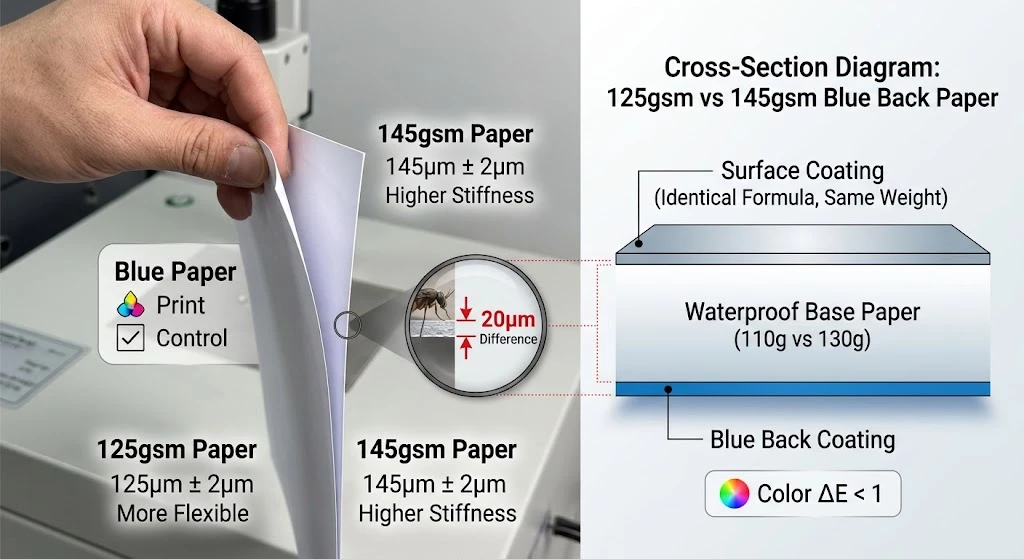
When it comes to 125gsm vs 145gsm blue back poster paper, the real difference comes down to the base paper itself. The 145gsm version uses a 130g/㎡ waterproof base paper, while the 125gsm uses a 110g/㎡ base paper. That extra 20g/㎡ gives the 145gsm paper about 20μm of extra thickness, which you can immediately feel in its overall stiffness.
Aside from thickness, everything else is identical: coating weight, surface gloss, whiteness, opacity, base paper moisture, and Lab color values. Both grades work seamlessly with standard eco-solvent, UV, and latex printable inks, delivering the exact same rich print quality and durable waterproof blue back billboard paper performance outdoors.
It's easy to assume that heavier paper always means better paper, but with these two, the print finish, color accuracy, and weather resistance are completely equal. The choice really comes down to where you are mounting it and what surface you are sticking it to, whether it's a billboard frame, a subway pillar, or a bus shelter wall.
The 145gsm is thicker and heavier, but if the mounting surface is soft, flexible, or aging, heavier paper puts more strain on the adhesive, making it easier to curl at the edges or peel off over time. On the other hand, the 125gsm option is lighter, placing less stress on the backing and holding firmly in place.
When it comes to hands-on installation, local workers definitely notice the difference. The stiffer 145gsm holds its shape without stretching out, but it can be trickier to bend around sharp edges or tight curves. The slightly thinner 125gsm offers much better flexibility, making it effortless for installers to smooth out air bubbles, conform to curved surfaces, and get the job done quickly. The following is the technical sheet for your reference.
| 125gsm vs 145gsm Blueback Poster Paper: Technical Comparison | ||
| Technical Specification | 125gsm Blueback Poster Paper | 145gsm Blueback Poster Paper |
| Product Code | FPH-125VMB | FPH-145VMB |
| Total Weight | 125 ± 2 g/m² | 145 ± 2 g/m² |
| Base Paper Weight | 110 g/m² Waterproof Base Paper | 130 g/m² Waterproof Base Paper |
| Total Thickness | 125 ± 2 μm | 145 ± 2 μm |
| Total Coating Weight | 15 ± 2 g/m² | 15 ± 2 g/m² |
| Base Paper Moisture Content | 2 ± 0.5% | 2 ± 0.5% |
| Gloss | 5 ± 0.5 | 5 ± 0.5 |
| Whiteness | 88 ± 1 | 88 ± 1 |
| Light Transmittance | 5% + 2% | 5% + 2% |
| Lab Values | L* 92 ± 1 / a* 0.5 ± 0.1 / b* 0.4 ± 0.1 | L* 92 ± 1 / a* 0.5 ± 0.1 / b* 0.4 ± 0.1 |
| Compatible Inks | Eco-Solvent, Solvent, Latex, UV & Screen Printing | Eco-Solvent, Solvent, Latex, UV & Screen Printing |
| Base Paper Type | Waterproof, high wet-strength base paper | Waterproof, high wet-strength base paper |
| Water Repellency | Hydrophobic lotus-effect coating | Hydrophobic lotus-effect coating |
| Outdoor Performance | Designed for outdoor advertising applications | Designed for outdoor advertising applications |
| Print Performance | High-resolution printing, color fidelity and vibrant image reproduction | High-resolution printing, color fidelity and vibrant image reproduction |
| Typical Applications | Billboards, OOH advertising columns, metro advertising, bus advertising and other outdoor applications | Billboards, OOH advertising columns, metro advertising, bus advertising and other outdoor applications |
Paper Weight and Thickness
When comparing 125gsm vs 145gsm blue back poster paper, the fundamental difference originates from the raw base paper inside. Understanding GSM (grams per square meter) is simple: it measures the weight of one square meter of paper—not the total roll weight—reflecting the material's basis weight and thickness.
Blue back poster paper consists of two core layers: a waterproof base paper and a surface functional coating. Both the 125gsm and 145gsm options use the exact same surface coating weight. The 125gsm paper is built on a 110g/m² waterproof base (totaling 125 ± 2 g/m² with a thickness of 125 ± 2 μm), whereas the 145gsm paper uses a 130g/m² waterproof base (totaling 145 ± 2 g/m² with a thickness of 145 ± 2 μm). When holding samples, the 145gsm feel noticeably sturdier and more rigid, while the 125gsm offers a lighter, more pliable feel.
However, a higher GSM or extra thickness doesn't automatically mean better overall quality. While basis weight contributes to structural feel and stiffness, a poster paper's real-world performance depends equally on coating precision, base paper strength, wet strength, waterproof durability, and large-format digital ink compatibility.
Stiffness and Handling
When choosing between 125gsm vs 145gsm blue back poster paper, selecting the right weight depends heavily on your application environment, site installation conditions, and overall project logistics.
The 145gsm version features a thicker base paper, offering superior paper stiffness and a noticeably sturdier hand-feel. It is ideal for display projects that demand long-term flatness without sagging or flopping—such as large-format pillar billboards and long-term bus shelter poster displays. The added structural rigidity helps the poster resist wrinkling and sagging under its own weight over time. On the other hand, the 125gsm lightweight option holds clear advantages in shipping, handling, and on-site mounting efficiency. For short-term event promotions, pop-up ads, or high-volume subway light box posters, lighter paper rolls save labor during transport, allow installers to smooth out sheets more easily, and speed up overall job completion.
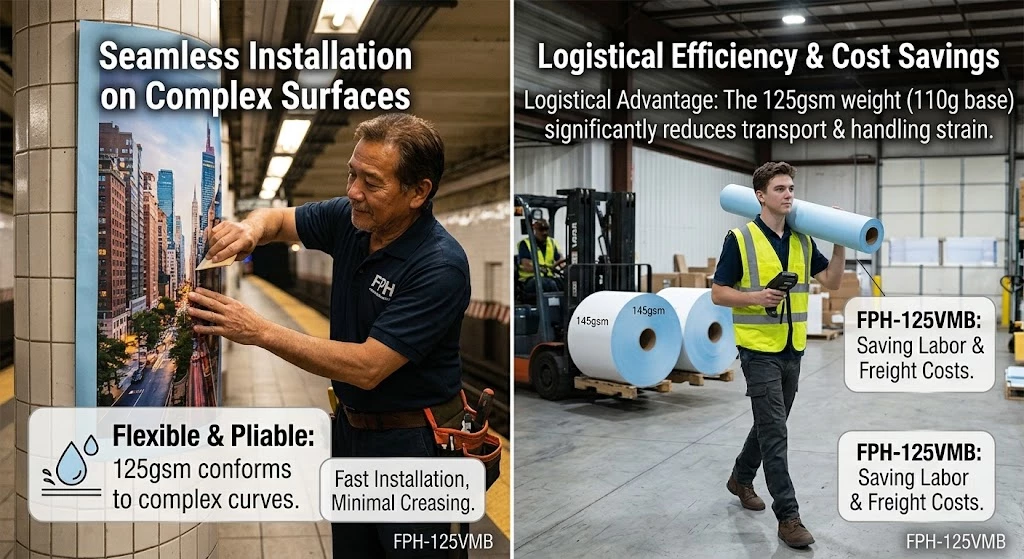
In large-scale poster printing projects, that 20g/m² weight difference adds up significantly. When dealing with broad square footage, the cumulative weight increase directly impacts freight expenses, handling labor, and installation schedules. For instance, a 1,000m² poster order results in a 20kg weight gap, while a citywide outdoor media campaign exceeding 10,000m² creates a weight difference of over 200kg—directly inflating sea freight, trucking, and ground-handling logistics costs.
It’s also important to remember that real-world performance depends on a combination of working conditions. Poster dimensions, mounting methods, outdoor weather exposure, and cutting or laminating equipment all influence the final result. For example, even stiff 145gsm paper on extra-wide format billboards is more prone to thermal expansion or distortion under extreme sun exposure compared to smaller sizes. Similarly, if automated cold laminators are used on-site, machine tension settings will affect how both 125gsm and 145gsm papers lay down during application.
Printing and Application Requirements
Both 125gsm and 145gsm blue back poster paper offer identical print compatibility, working seamlessly with eco-solvent, solvent, latex, UV inks, and screen printing across most digital printers.
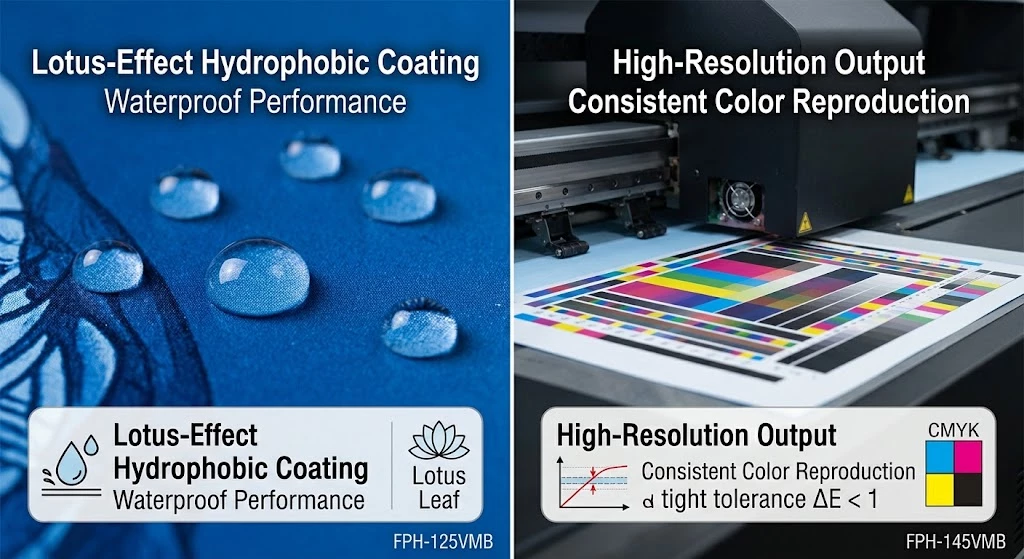
Key printing parameters are completely uniform—including 5±0.5 gloss, 88±1 whiteness, 5%±2% light transmittance, high wet-strength waterproof bases, and hydrophobic coatings. Printed under the same conditions, the color difference is imperceptible (Lab ΔE < 1), delivering the exact same vibrant color accuracy and high-resolution output regardless of poster size.
Because print performance is identical, your choice shouldn't be based on ink or print quality. Instead, select 125gsm blue back paper for short-term, high-volume campaigns to minimize shipping and installation costs, or 145gsm blue back paper for long-term large outdoor billboards that demand higher rigidity to stay perfectly flat.
125gsm Blueback Poster Paper: Key Features and Applications
Here is the concise, human-oriented English translation naturally incorporating Google SEO long-tail keywords for your product details page or spec sheet:
125gsm Blue Back Poster Paper – Key Specifications & Advantages:
Base Specifications: Total basis weight: 125 ± 2 g/m²; total thickness: 125 ± 2 μm. Built with a 110gsm waterproof, high wet-strength base paper and a 15 ± 2 g/m² functional coating. Lightweight rolls make handling and transport effortless.
Print Performance: Features 5 ± 0.5 gloss, 88 ± 1 whiteness, and 5% ± 2% opacity. Fully compatible with eco-solvent, solvent, latex, UV inks, and screen printing. Delivers stable color accuracy (ΔE < 1) with vibrant, high-resolution output.
Waterproof & Weather Resistance: Engineered with a lotus-effect hydrophobic surface that beads water right off for reliable outdoor durability. Controlled base paper moisture content (2 ± 0.5%) prevents warping in humid conditions.
Installation Advantages: Superior flexibility makes smoothing out air bubbles easy—ideal for curved or uniquely shaped mounting surfaces. Reduced weight per square meter significantly cuts freight and handling labor costs on high-volume projects.
Ideal Applications: Perfect for short-term outdoor promotion posters, subway lighting box displays, temporary bus shelter ads, and pop-up billboard campaigns where budget control and fast installation are priorities.
Real-World Cost Savings: On a 1,000m² campaign, switching to 125gsm cuts total material weight by 20kg compared to 145gsm, driving down shipping fees and field labor demands.
If your printing project calls for lightweight billboard paper that simplifies logistics and speeds up on-site mounting, 125gsm blue back poster paper is your most cost-effective, practical solution.
Core Specifications At a Glance:
Total Basis Weight: 125 ± 2 g/m²
Total Thickness: 125 ± 2 μm
Base Paper: 110gsm high wet-strength waterproof base
Surface Finish: Lotus-effect hydrophobic coating
Opacity: 5% ± 2% light transmittance
Printer Compatibility: Eco-Solvent, Solvent, Latex, UV, and Screen Printing
Color Output: High-resolution printability with consistent color reproduction
Typical Applications for 125gsm Blueback Paper
Our 125gsm blue back poster paper for outdoor advertising is engineered to perform across a wide range of display applications, including: Outdoor billboards and OOH advertising pillars, Subway lighting box and station displays, Bus shelter and transit advertising, Outdoor sales promotion posters, Short-term event and pop-up campaigns, Other large-format outdoor print projects.
For high-volume print runs requiring long-distance freight and quick field application, 125gsm strikes the sweet spot between structural durability and lightweight convenience.
Take a real-world example: A citywide summer brand campaign requiring 1,200m² of pillar posters. Choosing 125gsm over 145gsm reduces total shipment weight by 24kg. That means lighter rolls, easier warehouse handling, and noticeable savings on trucking costs. For a 3-month outdoor display cycle, this waterproof blue back billboard paper provides full weather resistance and vibrant color depth, while also being much easier to strip down once the campaign concludes.
It’s the ideal choice for short-term pop-up promotions and multi-location advertising rollouts—delivering striking visual impact and reliable waterproof performance while keeping your overall campaign budget well under control.
145gsm Blueback Poster Paper: Key Features and Applications
FPH-145VMB 145gsm Waterproof Blue Back Poster Paper – Product Overview & Key Advantages:
The FPH-145VMB 145gsm waterproof blue back poster paper features an upgraded 130gsm high wet-strength base paper, bringing total basis weight to a stable 145 ± 2 g/m² and overall thickness to 145 ± 2 μm. Compared to the 125gsm version, this extra thickness enhances structural rigidity and stiffness, giving the paper superior resistance to sagging, warping, and stretching under real-world outdoor conditions.
The core highlight of this product is premium performance without extra cost. Both the 125gsm and 145gsm grades share the exact same surface coating weight, coating formula, whiteness, light transmittance, color reproduction, and printer ink compatibility. In other words, you get the exact same vibrant print resolution, weather resistance, and waterproof blue back billboard paper performance—with the added bonus of extra thickness and paper stiffness.
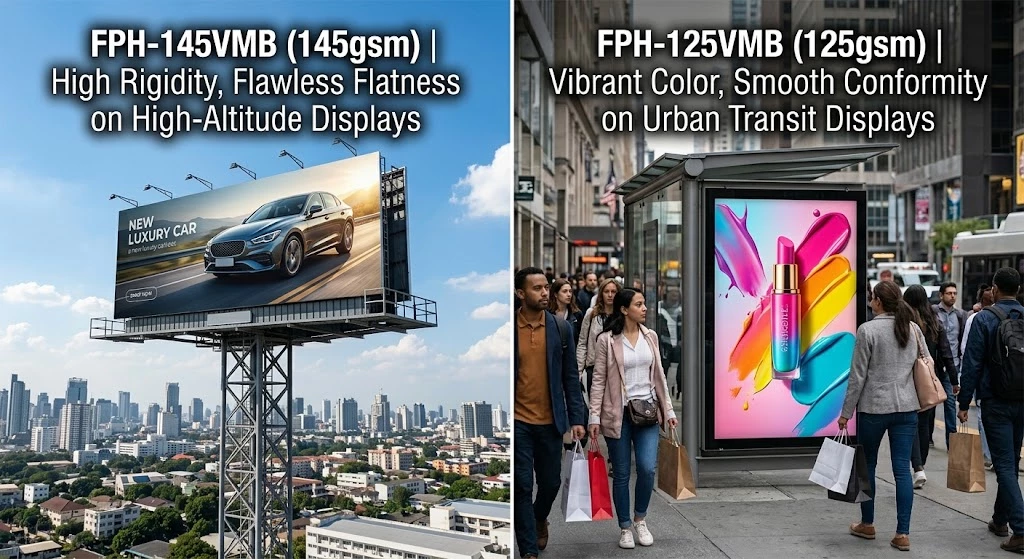
Real-World Application Example: Imagine mounting a 3-meter large-format poster on a high-altitude billboard. Under hot sun or light wind, 125gsm paper can sometimes experience slight edge curling or sagging over time. The sturdier 145gsm base paper stays rigid and flat, ensuring your large format outdoor poster remains crisp and seamless throughout long-term display cycles.
Why Choose 145gsm Blueback Poster Paper?
When your outdoor display demands long-term flatness, maximum rigidity, and superior structural stability, 145gsm blue back poster paper is the most reliable choice.
Sharing identical core specs with our 125gsm version—including 5% ± 2% opacity, a high-purity surface coating, and full compatibility with eco-solvent, solvent, latex, UV inks, and screen printing—145gsm delivers the exact same high-definition output and vibrant color accuracy. Its primary value isn't "better print quality," but rather unmatched stability during installation and long-term exposure. The added paper thickness and basis weight provide exceptional resistance to stretching, edge curling, and thermal distortion.
Real-World Application: For 6–12 month outdoor display cycles, high-altitude billboards, or wind-exposed wall banners, global advertising contractors consistently rely on 145gsm. The sturdier base structure prevents paper sagging, edge lifting, and moisture-induced warping, dramatically reducing post-installation maintenance and rework costs. It is the perfect heavyweight blue back billboard paper solution for high-profile projects, complex outdoor environments, and extended campaign lifespans.
Typical Applications for 145gsm Blueback Paper
While 145gsm blue back poster paper covers all standard outdoor advertising applications, it excels in high-standard, engineering-grade projects that demand long-term stability and maximum flatness.Primary Application Scenarios: Large-format fixed outdoor billboards, Long-term OOH advertising pillars, Extended commercial displays for subway stations and bus shelters, Full-wall outdoor advertisement displays, Fixed brand campaigns running longer than 3 months, High-end outdoor commercial signage demanding premium presentation
How to Choose Between 125gsm and 145gsm: It’s a common myth that one grade is for indoor use and the other for outdoor. In reality, both options are fully waterproof, heavy-duty blue back papers for outdoor advertising. The decision isn't based on indoor vs. outdoor, but rather on campaign duration, poster size, flatness requirements, and site installation conditions.
Choose 125gsm Blue Back Paper: Best for short-term events, monthly promotions, or high-volume orders exceeding 1,000m². It’s lightweight, cost-effective on freight, and highly efficient to install.
Choose 145gsm Blue Back Paper: Recommended for long-term brand displays, high-altitude large billboards, and high-visibility locations where optimal flatness, zero sagging, and minimal post-installation maintenance are top priorities.